Time-Space Center for Resistance to the Rule of the Emperor Mingus
The Robot Who Looked Like MeThe Time-Space Center for Resistance to the Rule of the Emperor Mingus is a gathering point for Gleisters from different potentialities, organized to challenge Emperor Mingus. Its first meeting gives the scattered group a name, a chairman, and a shared account of the danger it faces; it also exposes the vulnerability built into that solidarity, when the Emperor himself enters the gathering under another identity and turns its proceedings into a hostage crisis.
Formation and Purpose
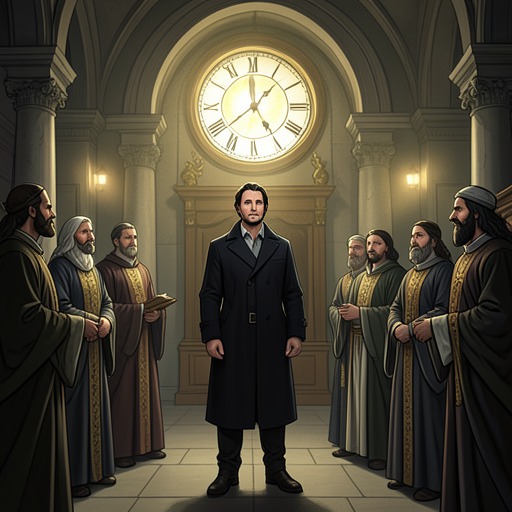
The Center takes shape at a meeting of the Gleister Coequality Line of Potentialities. Before opening the proceedings, the chairman asks those present to choose unusual names, reasoning that dozens of Toms or Georges would be little better than the many Charlies among them. He calls himself Egon, while Charlie Gleister, whose time-track the narrative has followed, adopts the name Hieronymous. The naming creates distinctions among people who share a family identity and helps make a meeting of multiple versions of the Gleisters intelligible as a collective.
Egon welcomes those who have reached the gathering by markedly different routes: some searched for it, some stumbled upon it, and others arrived while traveling elsewhere. He interprets this convergence as evidence that the place is a Gleister collection-point, though its cause remains unexplained. He proposes the Center’s name and identifies its political purpose: its members are, in his assessment, the only serious threat to Emperor Mingus’s reign. The title therefore turns an accidental or unexplained assembly into an expressly oppositional body.
Egon’s account makes the danger personal as well as political. Many of the assembled Gleisters, he says, have suffered inexplicable near-fatal accidents before inventing the time machine; he suspects that Mingus caused some of them and warns that further attempts on their lives may follow. The group’s founding premise is thus not merely that the Emperor rules unjustly, but that he may already be trying to eliminate the people capable of resisting him. Egon ends his opening remarks by inviting the floor, leaving the organization’s next steps open to discussion rather than announcing an established plan.
Membership and Knowledge
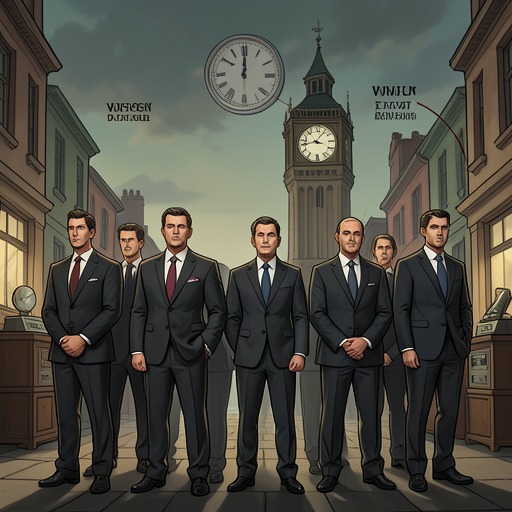
The gathering contains no single recognizable type of member. Its participants appear frightened or courageous, high-strung or phlegmatic, sociable or solitary, clever or confused. That range complicates any image of a disciplined resistance defined by uniform temperament. The Center’s initial coherence comes instead from shared identity, the convergence of their time-travel histories, and a common possible enemy.
Its knowledge of that enemy is incomplete. When Chalmers Gleister asks whether anyone has discovered Mingus’s identity, Egon says that the Emperor has concealed his origins effectively. An official biography claims that he was born in Clearwater, Florida, the only child of Anton and Myra Waldheim, but the meeting produces no independent confirmation. This uncertainty matters: the members can name the regime they oppose, yet cannot reliably identify the person at its head. Their political confidence and their informational weakness coexist from the outset.
The Meeting Turns Against Its Organizers
That weakness becomes decisive when Mordecai Gleister asks to address the assembly on what he calls urgent matters. He argues that the Emperor and his aims have not been impartially examined, challenging the group’s assumption that Mingus and his goals are evil. The intervention begins as a dispute over the resistance’s basic judgment: before deciding how to oppose the Emperor, the members should consider whether their condemnation is justified.
Hieronymous recognizes the confident, bearded man in his fifties, though at first he cannot place him. The recognition comes suddenly: he identifies Mordecai as Mingus and shouts for the others to seize him. Egon hesitates, then moves with Hieronymous toward the speaker; other Gleisters begin climbing onto the stage. Their attempt to act on the revelation stops when Mordecai draws a blue-steel automatic and aims it at Egon.
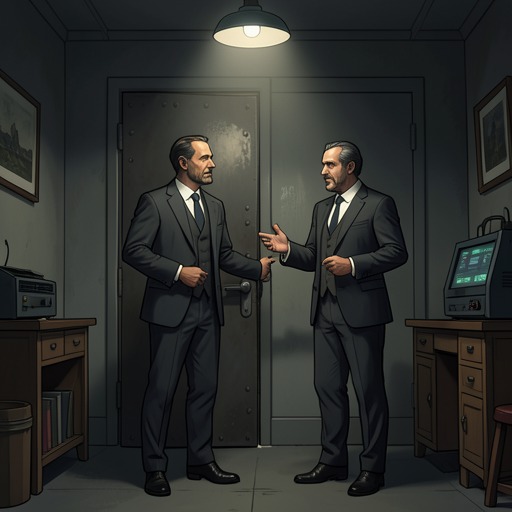
Mordecai orders the assembly to sit, allowing only Egon and Hieronymous to remain standing, and makes their lives conditional on everyone else’s good behavior. He explains that the weapon only resembles a Colt .45: it is his, or their, invention, operating by laser diffusion. At fifteen feet it first paralyzes its target, with death following seconds later unless the beam is switched off. The explanation converts the gathering’s numerical presence into a limited advantage; the threat is specific enough that any response must account for its range and effects. Mordecai then addresses the assembled Gleisters as his loyal subjects and reveals himself as Emperor Mingus.
Significance and Limits
The Center’s first meeting stages the resistance’s central contradiction. Its members have assembled because they believe they may be the only serious danger to Mingus, yet the Emperor is already inside their meeting, able to exploit their uncertainty about his identity and divide them with a weapon. The organization’s name asserts collective opposition; the scene immediately tests whether that opposition can recognize and contain the power it confronts.
The episode also reverses the apparent direction of Mordecai’s intervention. His appeal for impartial examination initially sounds like a challenge to the resistance’s assumptions, but Hieronymous’s recognition reframes it as an intervention by the very ruler whose identity the group cannot establish. The meeting does not show the Center’s later fate or the outcome of the standoff. It does establish the precarious conditions under which it begins: its members possess a shared cause, but their gathering point, leadership, and ability to act are exposed to the Emperor’s direct coercion.